Publishers have access to more monetization data than ever before.
Dashboards display hundreds of metrics.
CPMs rise.
RPMs fall.
Revenue grows.
Traffic declines.
At first glance, these signals can seem contradictory.
The problem is that different metrics measure different things.
A publisher focusing exclusively on CPM may miss important changes in user behavior.
A publisher focusing only on RPM may overlook inventory quality issues.
And a publisher that never measures session revenue may struggle to understand the true value of their audience.
Understanding the relationship between RPM, CPM, and session revenue is essential for making informed monetization decisions.
Why Metrics Matter
Metrics shape decisions.
If a publisher optimizes for the wrong metric, they may unintentionally damage long-term performance.
For example:
- A higher CPM may not increase total revenue.
- A higher RPM may not improve profitability.
- More impressions may not create more value.
Each metric tells part of the story.
The goal is understanding what each one measures and when it should be used.
What Is CPM?
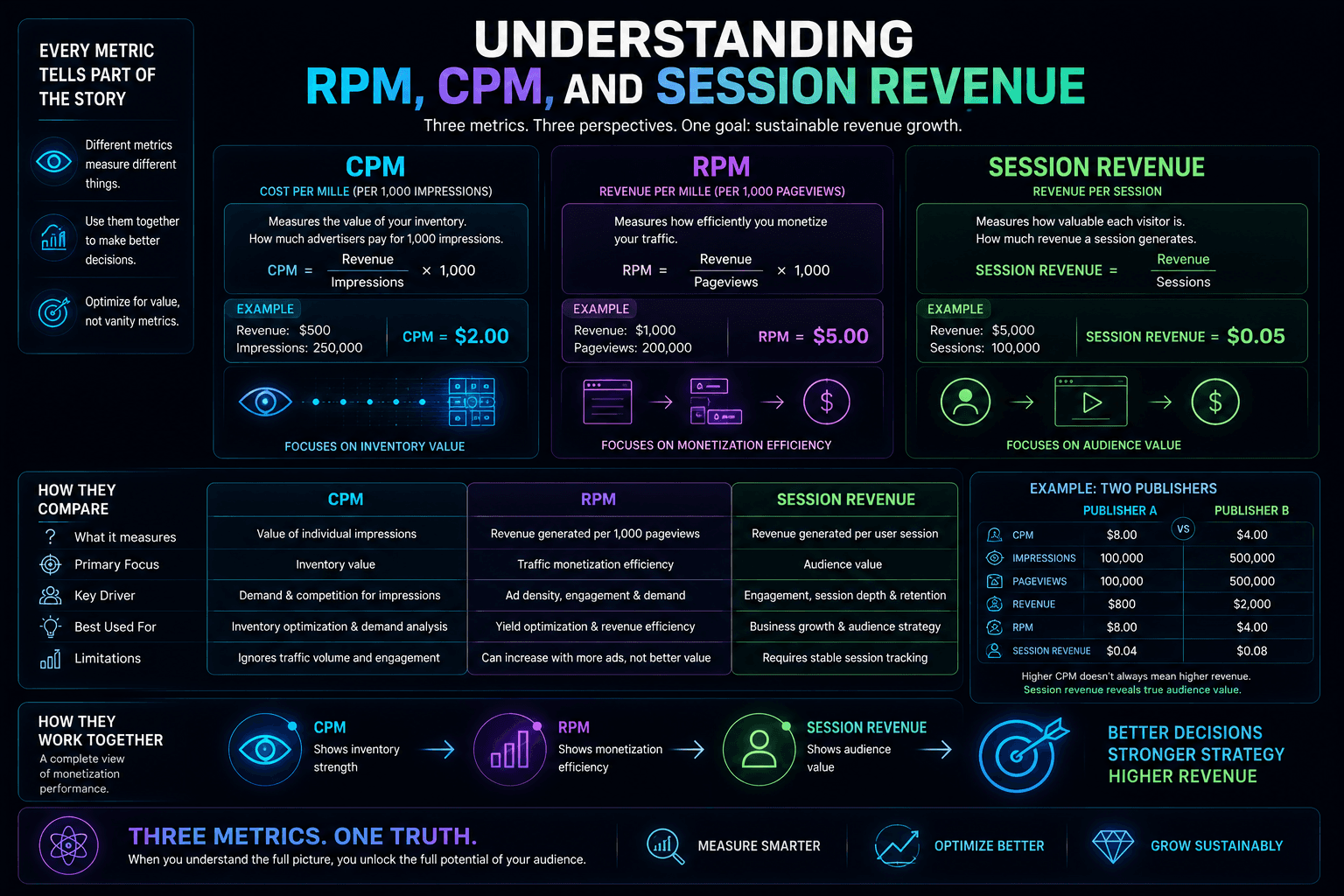
CPM stands for Cost Per Mille, or cost per thousand impressions.
It represents the amount advertisers pay for one thousand ad impressions.
The formula is simple:
Revenue ÷ Impressions × 1,000
For example:
- Revenue: $500
- Impressions: 250,000
CPM:
$500 ÷ 250,000 × 1,000 = $2.00
CPM measures inventory value.
Higher CPMs generally indicate:
- Stronger demand
- Better advertiser performance
- More valuable inventory
CPM is useful because it reflects how buyers value impressions.
However, CPM alone does not measure overall business performance.
The Limitation of CPM
Consider two publishers.
Publisher A:
- CPM: $8.00
- Impressions: 100,000
Publisher B:
- CPM: $4.00
- Impressions: 500,000
Publisher B generates more total revenue despite having a lower CPM.
This demonstrates an important point.
CPM measures impression value.
It does not measure audience value.
Nor does it measure total monetization performance.
What Is RPM?
RPM stands for Revenue Per Mille.
Unlike CPM, RPM measures revenue generated per thousand pageviews or sessions, depending on how it is calculated.
A common formula is:
Revenue ÷ Pageviews × 1,000
For example:
- Revenue: $1,000
- Pageviews: 200,000
RPM:
$1,000 ÷ 200,000 × 1,000 = $5.00
RPM helps publishers understand how effectively traffic is being monetized.
It combines multiple variables:
- Ad density
- Inventory quality
- User engagement
- Demand strength
- Monetization strategy
RPM is often more useful than CPM when evaluating overall revenue efficiency.
Why RPM Can Be Misleading
RPM is powerful.
It can also hide important details.
A publisher can increase RPM by:
- Adding more placements
- Increasing refresh rates
- Expanding inventory
Revenue may increase.
User experience may decline.
Traffic quality may weaken.
Advertiser performance may suffer.
RPM improves while long-term value decreases.
This is why RPM should never be viewed in isolation.
What Is Session Revenue?
Session revenue measures the amount of revenue generated during an individual user session.
Unlike CPM or RPM, session revenue focuses on audience value.
The formula is straightforward:
Total Revenue ÷ Total Sessions
For example:
- Revenue: $5,000
- Sessions: 100,000
Session Revenue:
$0.05 per session
This metric answers an important question:
"How valuable is each visitor?"
Why Session Revenue Matters
Session revenue aligns closely with business outcomes.
It captures factors that CPM and RPM often miss.
For example:
- Session duration
- Engagement depth
- Content consumption
- Return visits
- User quality
A publisher that improves session revenue often improves the overall health of the business.
Higher session revenue usually indicates:
- Better engagement
- Better attention
- Better monetization efficiency
Comparing the Three Metrics
Think of these metrics as measuring different layers of value.
CPM
Measures:
Inventory value
Question answered:
"How much is each impression worth?"
RPM
Measures:
Traffic monetization efficiency
Question answered:
"How much revenue do we generate from our traffic?"
Session Revenue
Measures:
Audience value
Question answered:
"How much revenue does each visitor create?"
Each metric is useful.
None tells the complete story alone.
A Practical Example
Imagine a publisher launches a redesign.
Results after 30 days:
- CPM increases by 15%
- RPM remains unchanged
- Session revenue increases by 25%
What happened?
The redesign likely improved engagement.
Users stayed longer.
They consumed more content.
Advertisers received better outcomes.
The audience became more valuable.
CPM alone would not fully explain the improvement.
Session revenue reveals the larger picture.
Which Metric Should Publishers Prioritize?
There is no single answer.
Different goals require different metrics.
For Inventory Optimization
Focus on:
- CPM
- Bid density
- Demand competition
For Monetization Efficiency
Focus on:
- RPM
- Revenue per pageview
- Revenue per user
For Long-Term Business Growth
Focus on:
- Session revenue
- Engagement
- Retention
- Audience quality
The strongest publishers monitor all three.
Building a Better Measurement Framework
Modern monetization is increasingly moving beyond traditional metrics.
Publishers now evaluate:
- Attention
- Engagement
- Viewability
- Demand pressure
- Session value
- Inventory quality
These signals provide additional context that helps explain why metrics change.
The goal is not simply tracking revenue.
The goal is understanding what creates revenue.
Conclusion
CPM, RPM, and session revenue are all important.
Each measures a different aspect of monetization performance.
CPM measures inventory value.
RPM measures monetization efficiency.
Session revenue measures audience value.
Publishers that understand the relationship between these metrics make better decisions, identify opportunities more quickly, and build stronger long-term monetization strategies.
The best measurement framework does not rely on a single metric.
It combines multiple perspectives to understand how value is actually created.