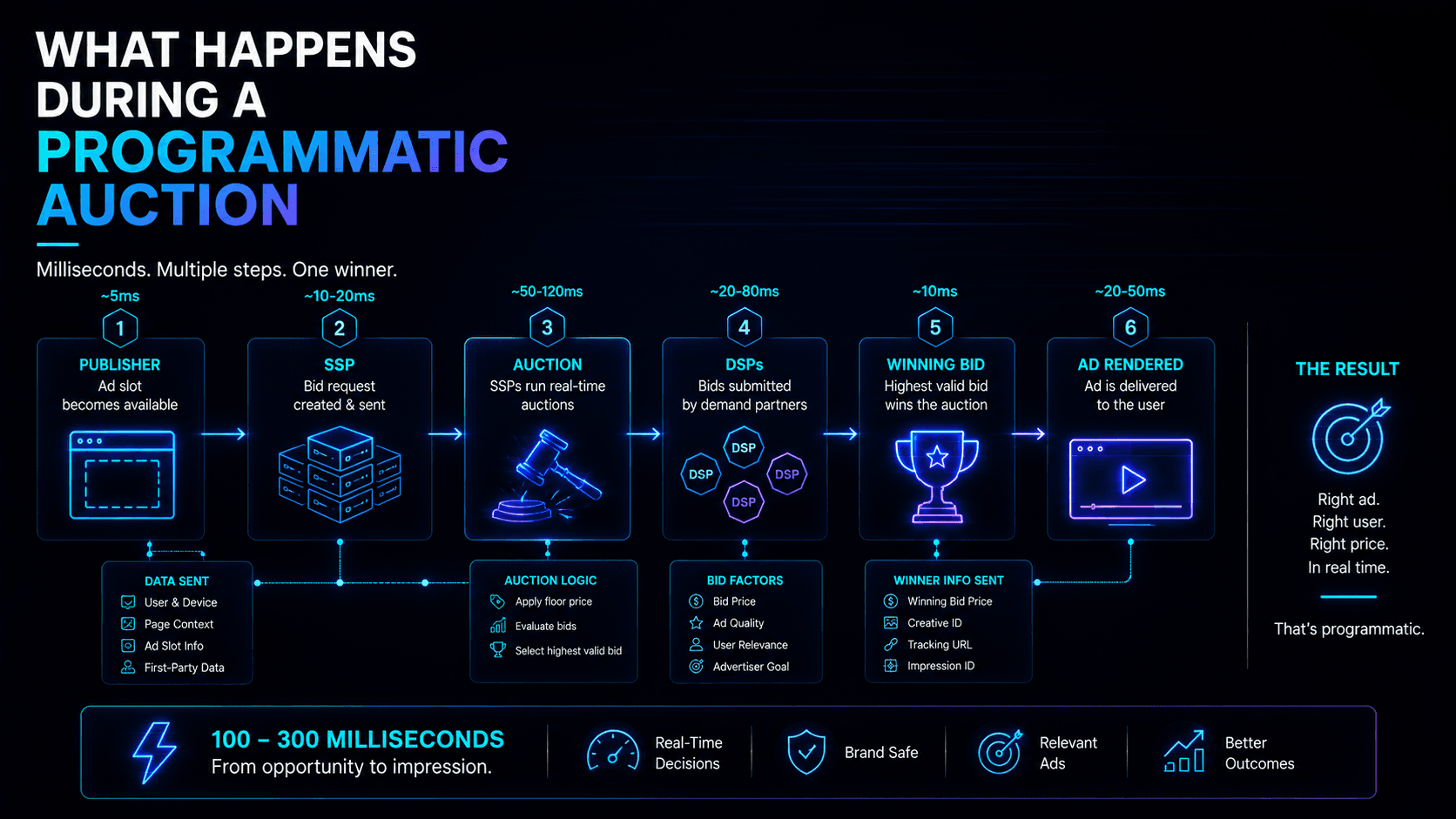
Every time a user opens a webpage, one of the fastest marketplaces in the world comes to life.
Within a fraction of a second, multiple advertising platforms communicate, evaluate the opportunity, submit bids, and determine which ad will be shown.
The process happens so quickly that users never notice it.
Yet behind every impression is a sophisticated auction involving publishers, advertisers, demand-side platforms, supply-side platforms, and real-time decision systems.
Understanding how this auction works is essential for anyone involved in digital advertising.
The Moment an Ad Opportunity Appears
The process begins when a webpage loads and an advertising placement becomes available.
At this moment, the publisher creates an opportunity.
The placement may be:
- A leaderboard
- A sidebar banner
- An in-content placement
- A video slot
- A native advertising position
Before an ad can be shown, the opportunity must be offered to potential buyers.
This is where the auction begins.
Step 1: The Publisher Sends a Bid Request
The publisher's monetization stack collects information about the opportunity and creates a bid request.
This request may include:
- Placement dimensions
- Device information
- Geographic information
- Page URL
- Content context
- User identifiers
- Privacy signals
- Viewability information
The bid request represents the inventory being offered to the market.
Think of it as a product listing in a marketplace.
Step 2: The Supply-Side Platform Receives the Request
The request is typically sent to a Supply-Side Platform (SSP).
The SSP acts as the publisher's representative.
Its role is to:
- Expose inventory to buyers
- Maximize competition
- Manage auction mechanics
- Return the highest-value ad
The SSP becomes the bridge between publishers and advertisers.
Step 3: The Auction Reaches Buyers
The SSP distributes the opportunity to multiple Demand-Side Platforms (DSPs).
DSPs represent advertisers.
Each DSP evaluates the opportunity independently.
Questions typically include:
- Is this user valuable?
- Does the content match campaign goals?
- Is the placement likely to perform well?
- Is the audience relevant?
- What is the expected return on investment?
Every DSP performs its own calculations in real time.
Step 4: Bidders Calculate Value
This is where most of the intelligence exists.
Modern bidders evaluate hundreds of signals within milliseconds.
Examples include:
- Audience quality
- Historical performance
- Contextual relevance
- Geographic location
- Device type
- Viewability probability
- Attention signals
- Conversion likelihood
Based on these signals, each bidder decides how much the impression is worth.
This value becomes the bid.
Step 5: Bid Responses Return
DSPs return bid responses containing:
- Bid price
- Creative information
- Advertiser details
- Tracking information
Not every bidder responds.
Some choose not to participate if the opportunity does not match campaign objectives.
Others submit highly competitive bids.
The result is a collection of competing offers.
Step 6: The Auction Determines a Winner
The SSP compares all valid bids.
The highest bid generally wins, although additional rules may apply.
Factors influencing the outcome may include:
- Floor prices
- Deal priority
- Direct campaigns
- Quality filters
- Auction mechanics
Once a winner is selected, the creative is returned to the publisher.
Step 7: The Ad Is Rendered
The winning advertisement is displayed to the user.
From the user's perspective, this appears instantaneous.
Behind the scenes, dozens of systems may have participated in the decision.
The entire process typically completes in less than a second.
Where Header Bidding Fits
Modern publishers often use Header Bidding before sending requests to an ad server.
Header Bidding allows multiple SSPs and demand sources to compete simultaneously.
Instead of relying on a single demand source, publishers create broader competition.
The result is often:
- Higher bid density
- Increased competition
- Better price discovery
- Higher revenue potential
This is why Header Bidding has become a standard part of modern monetization stacks.
Why Auction Dynamics Matter
Many publishers focus only on revenue reports.
However, understanding auction dynamics provides deeper insights.
Questions such as:
- How many bidders participated?
- How competitive was the auction?
- What was the demand pressure?
- How valuable was the impression?
often reveal more than CPM alone.
The auction itself contains valuable information about market conditions.
The Future of Programmatic Auctions
The next generation of auctions will become increasingly intelligent.
Rather than reacting to events, systems are beginning to predict them.
Publishers can now estimate:
- Demand pressure
- Viewability probability
- Attention levels
- Expected CPM
- Auction competitiveness
before an impression is sold.
This shift transforms monetization from simple auction participation into intelligent decision making.
Conclusion
A programmatic auction may last only a few hundred milliseconds, but an enormous amount of information flows through the system during that time.
Publishers create opportunities.
SSPs distribute them.
DSPs evaluate them.
Advertisers compete for them.
The highest-value bid wins.
Understanding this process helps publishers move beyond simple revenue reporting and begin understanding the market forces that drive auction outcomes.
Because every impression is more than an ad request.
It is a real-time marketplace operating at global scale.