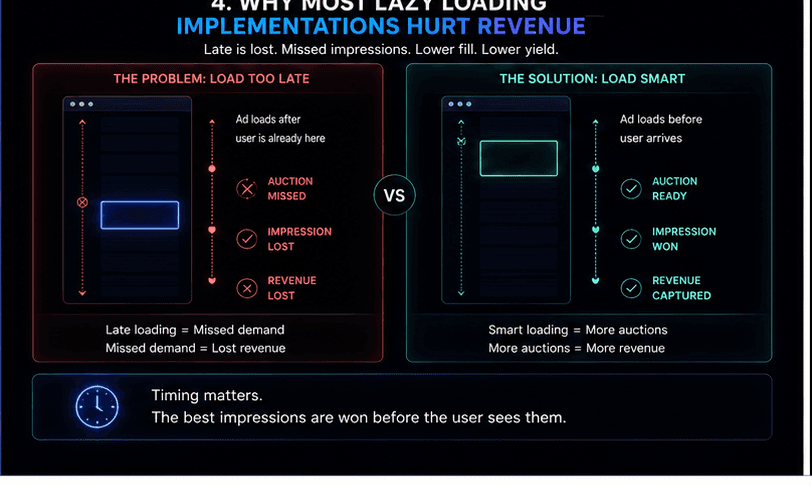
Lazy loading can improve performance, but poor thresholds and timing often reduce competition, viewability, and revenue.
Publisher engineering sits at the point where product performance, ad operations, privacy, and revenue strategy meet.
The Technical Foundation
Every monetization system depends on reliable signals, clean integrations, and predictable timing. Small engineering choices around loading, request shape, consent propagation, identity modules, or auction timeout can have large revenue effects.
Where Things Usually Break
Most problems are not caused by one dramatic failure. They come from accumulated friction: slow auctions, weak bid requests, incomplete context, poor refresh rules, inconsistent slot IDs, missing privacy signals, or layouts that create viewability without attention.
What Good Implementation Looks Like
A strong implementation is observable, modular, and easy to evolve. It should expose auction events, connect bids to rendered slots, preserve user experience, and give revenue teams the data they need to make decisions.
Why Engineering Is Strategic
Publisher monetization is no longer just configuration. Engineering quality directly shapes demand access, auction competition, page performance, and buyer trust.
Conclusion
The best publisher stacks are built as revenue infrastructure. They are fast, transparent, privacy-aware, and designed to let every impression reach the market with the strongest possible context.